

STABILIZING ACTION IS MADE IMMEDIATE
Vac-Pac Plus® Drinking Water Vaccine Stabilizer
Protecting live vaccines begins with the water that carries them.
Vac-Pac Plus® from Animal Science Products is a concentrated, water-soluble vaccine stabilizer designed to help protect live vaccines during drinking-water administration in poultry and swine.
Its formulation addresses three important water-quality threats: oxidizers, pH imbalance, and low tonicity. By helping manage these conditions, Vac-Pac Plus supports a more suitable water environment for live vaccine administration.
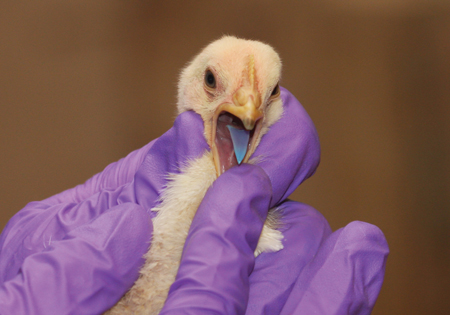
Vac-Pac Plus also provides an intense blue visual indicator that helps vaccination crews observe treated-water mixing and movement throughout the drinking-water system.
Key Benefits
-
Oxidizer Protection — Helps reduce the harmful effects of chlorine and other oxidizing agents.
-
pH Buffering — Helps manage acidic and alkaline water conditions.
-
Electrolyte Balance — Supports appropriate tonicity for sensitive vaccine organisms.
-
Blue Visual Indicator — Helps crews monitor treated-water distribution through drinking lines.
Always follow the current Vac-Pac Plus label and the vaccine manufacturer's instructions.
Find an ASP
Why Water Quality Matters During Vaccination
Water is more than a delivery method for live vaccines. Its chemical properties can influence vaccine stability before the vaccine reaches poultry or swine through the drinking-water system.
Even when vaccines are correctly prepared and administered, untreated water may contain conditions that compromise the viability of sensitive vaccine organisms.
Three important water-quality threats deserve particular attention.
Oxidizers — Chlorine and Other Sanitizers
Chlorine and other oxidizing sanitizers help maintain drinking-water hygiene, but residual oxidizing activity can damage live vaccine organisms during administration.
Water that is suitable for routine sanitation is not necessarily suitable for carrying a live vaccine without preparation.
pH Imbalance — Acidic or Alkaline Water
Water pH can influence the stability of live vaccines. Excessively acidic or alkaline conditions may expose vaccine organisms to an unfavorable environment during preparation and delivery.
Appropriate buffering helps manage variations in water pH and supports more consistent conditions for vaccine administration.
Low Tonicity — Inadequate Electrolyte Balance
Live bacterial vaccines can be particularly sensitive to the osmotic conditions of their surrounding water.
Water with insufficient tonicity can cause susceptible bacterial cells to absorb water, swell, and rupture. Maintaining appropriate electrolyte balance helps protect these organisms during vaccine preparation and administration.
How Vac-Pac Plus® Supports Vaccine Stability
Vac-Pac Plus® helps prepare drinking water for live vaccine administration by addressing three important water-quality conditions: oxidizers, pH imbalance, and low tonicity.
Its concentrated, water-soluble formulation combines oxidizer protection, pH buffering, and electrolyte balance to help maintain a more suitable environment for sensitive vaccine organisms during preparation and delivery.
1. Reduces Harmful Oxidizing Activity
Vac-Pac Plus helps reduce the harmful effects of chlorine and other oxidizing agents that can compromise live vaccine viability.
This protection is particularly important when drinking water contains residual sanitizers that could otherwise damage vaccine organisms before they reach the animals.
2. Buffers Water pH
Vac-Pac Plus incorporates a buffering system designed to help manage both acidic and alkaline water conditions.
By buffering the prepared water toward a more suitable pH, Vac-Pac Plus helps reduce exposure to unfavorable conditions during vaccine preparation and administration.
3. Supports Appropriate Electrolyte Balance
Vac-Pac Plus provides electrolytes to help maintain appropriate tonicity in prepared vaccine water.
This is especially relevant for sensitive live bacterial vaccines, which can be affected by osmotic imbalance. The formulation supports electrolyte balance without relying on fermentable sugars.
Three water-quality challenges. One preparation step.
By addressing oxidizers, pH imbalance, and low tonicity together, Vac-Pac Plus helps producers prepare a more suitable drinking-water environment for live vaccine administration.
Vac-Pac Plus® Protection Against the Triple Threat to Vaccine Stability
Live vaccines administered through drinking water face three important water-quality threats: oxidizers, pH imbalance, and low tonicity. Together, these conditions represent what Animal Science Products calls the Triple Threat to Vaccine Stability.
Vac-Pac Plus® is formulated to address all three threats in one water-preparation step, helping create a more suitable environment for live vaccine administration in poultry and swine.
The Triple Threat to Vaccine Stability
Three water-quality conditions that can compromise live vaccines during drinking-water administration.
OXIDIZERS
Chlorine and other oxidizing agents can damage sensitive live vaccine organisms.
pH IMBALANCE
Acidic or alkaline conditions can create an unfavorable environment for vaccine stability.
LOW TONICITY
Inadequate osmotic balance can damage susceptible live bacterial vaccine organisms.
Vac-Pac Plus®
A concentrated, water-soluble stabilizer formulated to address all three water-quality threats.
Helps reduce harmful oxidizing activity.
Helps manage acidic and alkaline water conditions.
Supports appropriate tonicity in prepared water.
Vac-Pac Plus helps prepare drinking water for label-directed vaccine administration in poultry and swine.
Always follow the current Vac-Pac Plus label and the vaccine manufacturer's instructions.
Make the Invisible Visible:
The Vac-Pac Plus® Blue Indicator
During drinking-water vaccination, it can be difficult to observe how treated water moves through a watering system.
Vac-Pac Plus® includes an intense blue visual indicator that makes treated water easier to recognize during preparation and distribution.
The visible blue color helps vaccination crews observe mixing and track the movement of treated water through drinking lines, providing a practical visual reference during vaccine administration.
A Visual Aid for Vaccination Crews
Visible Water Treatment — The blue color helps crews distinguish treated water from untreated water.
Mixing Observation — The indicator provides a visible reference when preparing and mixing treated water.
Drinking-Line Distribution — The blue color helps crews observe the movement of treated water through the watering system.
Practical Application — The indicator supports visual monitoring during the drinking-water vaccination process.
Research & Technical Evidence Behind Vac-Pac Plus®
The performance of a live vaccine administered through drinking water depends in part on the conditions of the water used to prepare and deliver it.
Animal Science Products provides technical information and supporting research addressing the effects of oxidizers, pH imbalance, and low tonicity on live vaccine stability.
These resources help explain the scientific principles behind Vac-Pac Plus® and its role in drinking-water vaccine preparation.
Oxidizers and Live Vaccine Stability
Residual chlorine and other oxidizing agents can compromise live vaccine organisms during drinking-water administration.
ASP's technical materials discuss the importance of controlling oxidizing activity in vaccine water and describe evaluations involving chlorine exposure and vaccine stabilization.
The Importance of Water pH
Both acidic and alkaline water conditions can create challenges for live vaccine stability.
ASP's technical materials describe the buffering characteristics of Vac-Pac Plus® and include comparative pH evaluations illustrating how water conditions change during stabilizer preparation.
Tonicity and Live Bacterial Vaccines
The osmotic environment surrounding live bacterial vaccine organisms is another important consideration during drinking-water vaccination.
ASP's technical materials explain the role of electrolyte balance in supporting appropriate tonicity and describe why low-tonicity water can be harmful to susceptible bacterial cells.
What the Research Shows: Oxidizer Protection
Chlorine is widely used to help maintain drinking-water hygiene. However, residual chlorine can also damage live vaccine organisms when vaccines are administered through drinking water.
A 2012 laboratory evaluation conducted by Whitbeck Laboratories examined the stability of a live Salmonella choleraesuis vaccine in water containing 4 ppm free chlorine.
The evaluation compared three water conditions: nonchlorinated control water, chlorinated water without stabilizer, and chlorinated water treated with an ASP-provided stabilizer.
The findings demonstrated the importance of preparing chlorinated water before introducing a sensitive live vaccine.
How Chlorine Affected Live Vaccine Recovery
Whitbeck Laboratories evaluated a live Salmonella choleraesuis vaccine under three water conditions, including water containing 4 ppm free chlorine.
Nonchlorinated Water
Nonchlorinated water served as the reference condition for evaluating recoverable vaccine organisms.
4 ppm Chlorine Without Stabilizer
No vaccine organisms were recovered at any of the four tested intervals: 0, 2, 4, or 6 hours.
4 ppm Chlorine With ASP Stabilizer
Vaccine counts remained similar to the nonchlorinated control throughout the six-hour evaluation.
Under the tested laboratory conditions, chlorine exposure prevented recovery of the live vaccine organisms, while treatment with an ASP-provided stabilizer supported recovery comparable to the nonchlorinated control.
Research source: Whitbeck, G. L. (2012). Vaccine stability trial: Stability of Enterisol® SC-54 live Salmonella choleraesuis vaccine in water containing free chlorine with and without an ASP water stabilizer. Unpublished laboratory report prepared for Animal Science Products, Inc. November 7, 2012.
Results describe the specified laboratory conditions and should not be interpreted as a guarantee of vaccine viability or immunization outcomes in other conditions.
What the Research Shows: Water pH and Buffering
Water pH is an important consideration when preparing live vaccines for drinking-water administration. Both acidic and alkaline conditions can create an unfavorable environment for sensitive vaccine organisms.
Vac-Pac Plus® incorporates a buffering system designed to help manage variations in water pH.
ASP's technical evaluations describe how Vac-Pac Plus maintains a prepared stock solution near pH 7.8, helping reduce the risk of exposing live vaccines to unfavorable acidic or alkaline conditions.
Buffering Toward a More Suitable pH
Vac-Pac Plus® is formulated to help manage acidic and alkaline water conditions during drinking-water vaccine preparation.
Acidic Water
Low-pH conditions can create an unfavorable environment for sensitive live vaccine organisms.
Vac-Pac Plus®
A buffering system designed to manage water pH during vaccine preparation.
Alkaline Water
High-pH conditions can also create challenges for live vaccine stability.
The approximately 7.8 pH value is reported in ASP technical materials for a prepared stock solution. It is not a guaranteed final pH for every water source or mixing condition.
What the Research Shows: Tonicity and Live Bacterial Vaccines
Live bacterial vaccines can be especially sensitive to the osmotic conditions of the water used during preparation and administration.
When water contains insufficient electrolytes, susceptible bacterial cells may absorb excess water, swell, and rupture. This is one reason low tonicity is identified as part of the Triple Threat to Vaccine Stability.
ASP's technical materials explain that Vac-Pac Plus® provides electrolyte balance to help support a more suitable water environment for sensitive live bacterial vaccines, including those involving Mycoplasma and Salmonella.
Unlike chlorine neutralization or pH buffering, tonicity management addresses the physical movement of water across susceptible bacterial cell membranes
Why Electrolyte Balance Matters
The surrounding water environment can influence the integrity of susceptible live bacterial cells.
Low-Tonicity Water
Insufficient electrolyte balanceSusceptible bacterial cells may absorb excess water, swell, and rupture under unfavorable hypotonic conditions.
Electrolyte-Balanced Water
A more suitable osmotic environmentVac-Pac Plus® provides electrolytes to help support a more suitable environment for sensitive vaccine organisms.
By addressing electrolyte balance alongside oxidizers and pH imbalance, Vac-Pac Plus helps manage three important water-quality considerations during vaccine preparation.
Conceptual illustration only. Cell response varies by organism and water conditions. This diagram does not represent a specific Vac-Pac Plus experimental measurement.
Practical Advantages of Vac-Pac Plus® Vaccine Stabilizer
Successful drinking-water vaccination requires more than selecting the correct vaccine. Water preparation, mixing, and distribution are also important parts of the process.
Vac-Pac Plus® combines three water-stabilizing functions with a visible blue indicator in a concentrated, water-soluble formulation designed for drinking-water vaccine administration.
These features help vaccination crews prepare treated water and observe its distribution throughout the watering system.
Convenient Water Preparation
Vac-Pac Plus® is formulated to dissolve readily in water, helping crews prepare stabilized drinking water without the prolonged dissolution period associated with some effervescent stabilizers.
Always follow the current product label and vaccine manufacturer's mixing instructions.
Three Stabilizing Functions in One Product
Vac-Pac Plus® addresses oxidizers, pH imbalance, and low tonicity through its combined oxidizer-protection, buffering, and electrolyte-balancing functions.
This provides a practical approach to managing the Triple Threat during drinking-water vaccine preparation.
Visible Distribution Through Drinking Lines
The intense blue indicator helps crews recognize treated water and observe its movement through the watering system.
This visual reference can support monitoring during preparation, line priming, and distribution.
Designed for Poultry and Swine Vaccination Programs
Vac-Pac Plus® is designed for drinking-water vaccine administration in poultry and swine.
Its water-stabilizing functions support the preparation of a more suitable delivery environment for sensitive live vaccines, subject to the applicable product and vaccine label instructions.
Vac-Pac Plus® Application and Packaging
Vac-Pac Plus® is designed for use in drinking-water vaccine administration programs for poultry and swine.
Proper preparation of the drinking water is an important part of the vaccination process. Vac-Pac Plus helps address oxidizers, pH imbalance, and low tonicity before sensitive live vaccine organisms are introduced into the prepared water.
Always follow the current Vac-Pac Plus product label, the vaccine manufacturer's instructions, and the applicable veterinary vaccination protocol.
Preparing Water for Vaccination
1. Prepare the drinking-water system. Follow the vaccination protocol and applicable water-system preparation procedures.
2. Add Vac-Pac Plus®. Prepare the water using the mixing directions specified for the particular Vac-Pac Plus product presentation.
3. Mix before adding the vaccine. Distribute the stabilizer thoroughly in the water. The blue indicator provides a visible reference for mixing.
4. Introduce the vaccine. Follow the vaccine manufacturer's instructions for reconstitution, mixing, and administration.
5. Monitor distribution. Observe the blue-treated water as it moves through the drinking-water system, following the applicable vaccination protocol.
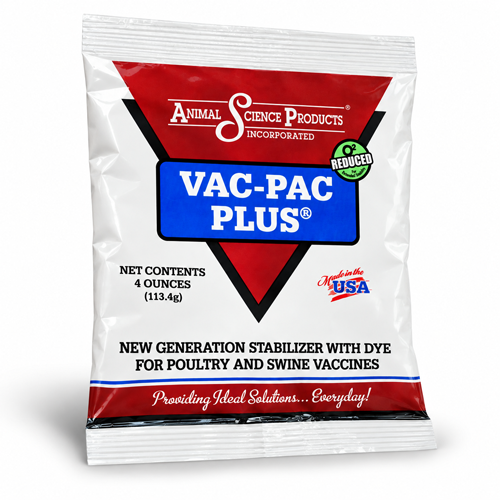
Vac-Pac Plus® — 4 oz (113.4 g) Sachet Drinking-Water Vaccine Stabilizer for Poultry and Swine
Vac-Pac Plus® Technical Resources & Supporting Research
Understanding the science behind drinking-water vaccine stabilization helps producers make informed decisions about vaccine preparation and administration.
Animal Science Products provides technical references covering oxidizer protection, pH buffering, electrolyte balance, and practical considerations for administering live vaccines through drinking-water systems.
Explore the resources below for additional information about the water-quality challenges addressed by Vac-Pac Plus®.
Evolution of Live Vaccine Administration
Explore developments in drinking-water vaccination, water-quality challenges, and advances in vaccine stabilization practices.
View Technical ResourceThe Water Is Part of the Dose
Learn how chlorine, pH, and electrolyte balance affect the water used to administer live vaccines, with a focus on swine vaccination.
View Technical ResourceAdvantages Over Effervescent Powders and Tablets
Review ASP's technical comparison covering dissolution characteristics, pH buffering, and tonicity considerations.
View Technical ResourceASP Vaccine Stabilizer Technical Brochure
Explore ASP's vaccine stabilizer information, including the Triple Threat, product features, technical charts, and supporting references.
View Technical ResourceQuestions About Vac-Pac Plus?
Learn more about Vac-Pac Plus applications, technical research, and product information for hatchery vaccination programs.
Contact Animal Science Products to discuss Vac-Pac Plus with our team using our form below.
Additional Product Information and Articles on Vac-Pac Plus®
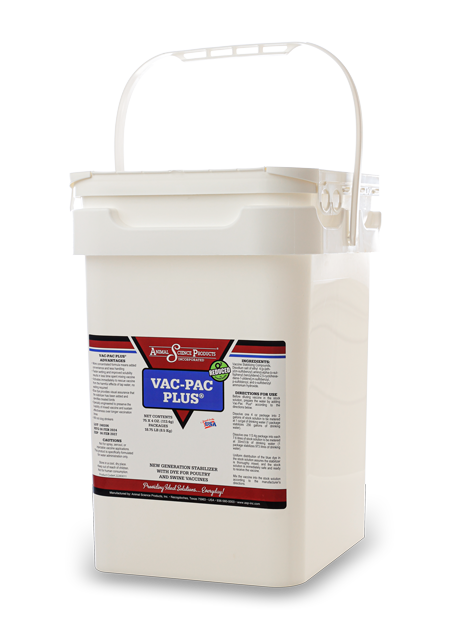
SpecSheet | SDS For use in drinking water when administering water vaccines to neutralize factors that destroy vaccines. Dyes water with blue color to indicate even distribution of vaccine through entire water system. Seventy-Five 4 oz. packages per reusable container.
The Water is Part of the Dose PDF | ARTICLE
Vaccine Stabilizer Brochure ENGLISH | SPANISH | CHINESE | RUSSIAN A4
Evolution of Live Vaccine Administration
Advantages over Effervescent Powders & Tablets
Effect of Vac-Pac Plus on Viability of live IB vaccine (WHITE PAPER)
Stabilizing Aquasol® Fenbendazole In Livestock Drinking Water
Vac-Pac Plus Field-Proven Stabilization of Poultry Mycoplasma Vaccine Article
Mailing Address:
Animal Science Products, Inc
PO Drawer 631408
Nacogdoches, TX 75963 - 1408
Physical Address:
3418 Rayburn Drive
Nacogdoches, Texas 75961
Phone
936.560.0003